
 By Colin Allen
Realwear Reviews & Recommends Uvisan UV-C cabinets to sanitise its headsets
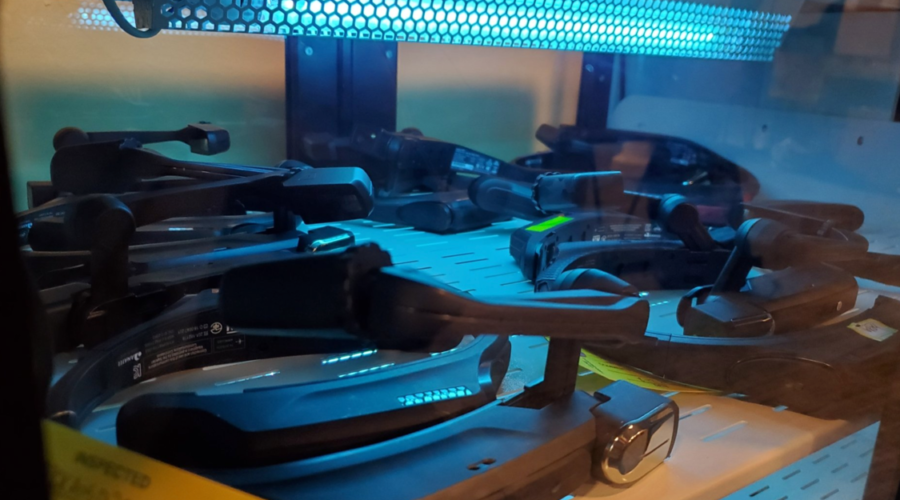
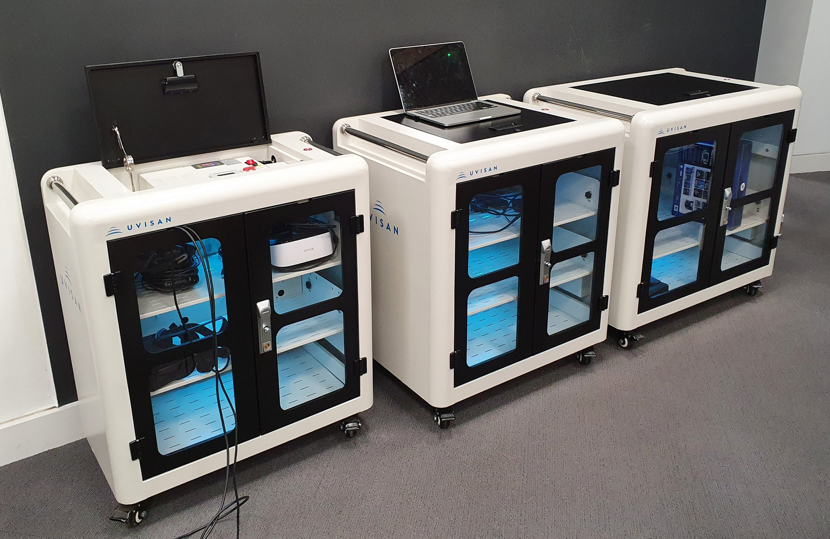
Wearable, Assisted-Reality specialists Realwear recently were kind enough to review a Uvisan UV Cabinet and provided a detailed and comprehensive report on the overall usability and findings when testing their Headsets.
In summary Realwear’s findings were:
- Test simulates 6 cleaning cycles per day, 52 weeks per year, for 4 years.
- No visible degradation to HMT – 1 devices after testing.
- All devices remained in working order and passed drop tests after testing.
- Realwear recommends Uvisan UV Cabinets for hygiene purposes for all Realwear devices at customers discretion.
About Realwear
RealWear’s assisted reality tools enable frontline workers to view and share documents, diagrams, photos, and video, all while keeping their hands and field of view free for the work. Leading software companies have optimized their applications, enabling workers to virtually connect and collaborate with remote experts as though working side by side, and to follow complex work procedures or remotely complete audits or inspections. Voice controlled, simple commands – even in high noise environments – allow workers to intuitively navigate critical applications, documentation, and functions. The only wearable purpose-built as ruggedized, RealWear is fully compatible with worker PPE (helmets, protective suits, ear protection and safety glasses), and features the only “all shift” battery life available. Professional grade and designed for commercial use, RealWear solutions fully integrate with enterprise-class software, security protocols, and with a variety of device management solutions.
Realwear were sent a Uvisan UV Cabinet to evaluate the effects on Realwear products and the results can be seen below.
HMT-1 Ultraviolet Exposure Test
Determining UVC effect on cosmetic degradation using Uvisan device
Realwear, Inc.
Abstract
Over the past year, multiple customers have been interested in using UV radiation to sanitize the HMT-1. Realwear needs to determine the cosmetic effects of long-term UVC exposure before providing a specific recommendation. Realwear is working with Uvisan, a company that designs commercial VR sterilization boxes used in sanitising VR, AR and MR headsets in VR arcades, training facilities, education facilities, retail kiosks, and other VR experiences and settings. Uvisan offers a range of UVC Cabinets for storing, charging and sanitising up to 30 headsets in 2 minutes.
Uvisan provided a material testing protocol, which notes that there have been no discoloration or physical degradation of any materials tested. To test our device, we first took high res photos of the cosmetic surfaces, and then used a Uvisan to expose the device for 144 hours of UV sanitising, equivalent to 6 cleanings per day, 52 weeks, for 4 years.
After comparing the before and after photos, we determined that the Uvisan UV Cabinet does not affect the cosmetic surfaces of the HMT-1 and recommend at the customers discretion. We also performed a post-UVC drop test according to the RW HMT-1 Drop Test Standard. The device passed with fully working physical and electrical components.
Introduction
Currently, when our customers need to sanitize the HMT-1, we recommend wiping the device using an alcohol solution. With the events of COVID-19, customers have expressed interest in using ultraviolet radiation to sanitize the device, although Realwear is unsure of the cosmetic effects on the materials. To research this further, we started working with providers of VR sterilization boxes used in VR arcades, training facilities, and retail kiosks, to setup a UVC exposure test. The goal of this experiment is to determine the level of cosmetic degradation that our new device (Codenamed: Archer) shows after four years of simulated exposure. Note that Uvisan claims “there have been no discoloration or physical degradation of any material tested”. We will also perform a drop test, to ensure that the HMT-1 remains rugged after UVC cleaning.
Literature Review
Ultraviolet radiation in the UVC band has been used for decades to reduce the spread of bacteria. Recently, it has also been shown to destroy proteins in the SARS-Coronavirus. To effectively inactivate a virus, UVC radiation needs direct exposure to the surface, and so fabrics and foams are more difficult to sanitize than plastics.1 The HMT’s hard and non-porous materials (excluding the workband, rear pad, and overhead strap) are conducive for UVC sanitization, since the UVC radiation has direct exposure to surfaces and shallow crevices.
Theory
UVC lies in the band from 200 to 280 nanometers, and inactivates viruses and bacteria by interacting with the RNA and DNA molecules to render the microbes non-infectious (Uvisan cabinets use specifically 254 nanometers). Unlike UVA/UVB produced by the sun, UVC is a shorter wavelength with different properties that does not noticeably degrade or damage electronics, plastics, lenses, or other materials commonly used in VR headset construction.3 Since the HMT-1 is a full shift device, we assume that it will be used at most during a 24 hour work day, comprised of three 8 hour shifts. Exposing the device to UVC radiation for 1 minute, 3 times a day, for four years of use results in 4380 minutes of exposure over the devices lifetime. Using a 2x factor of safety, we tested this device for 8640 minutes, 6 days of continuous exposure. By simulating four years of exposure, we will be determine UVC cosmetic effects on the HMT-1.
Experiment
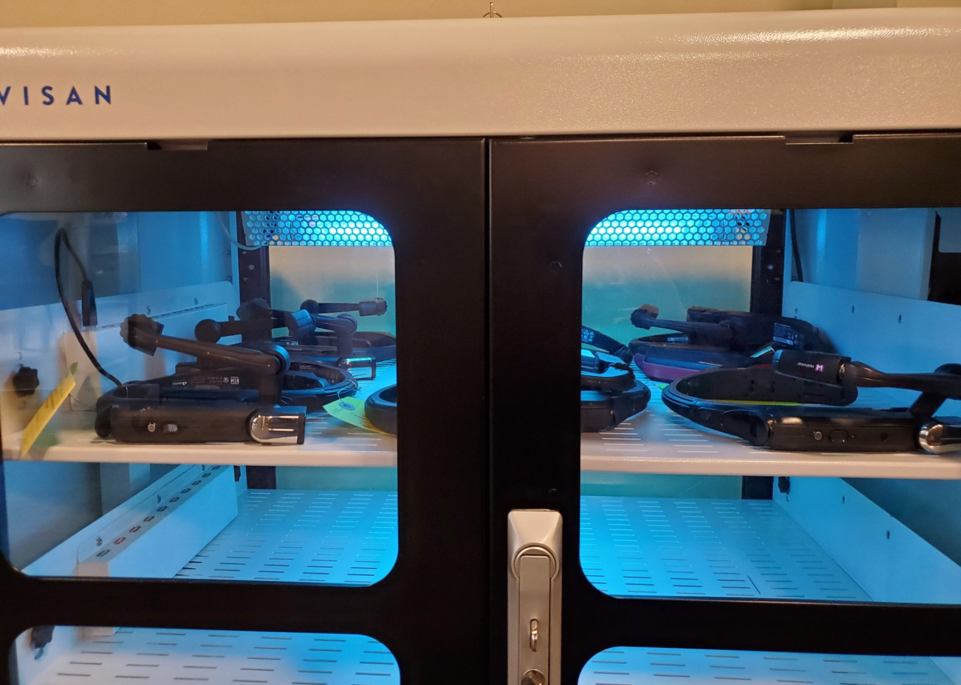
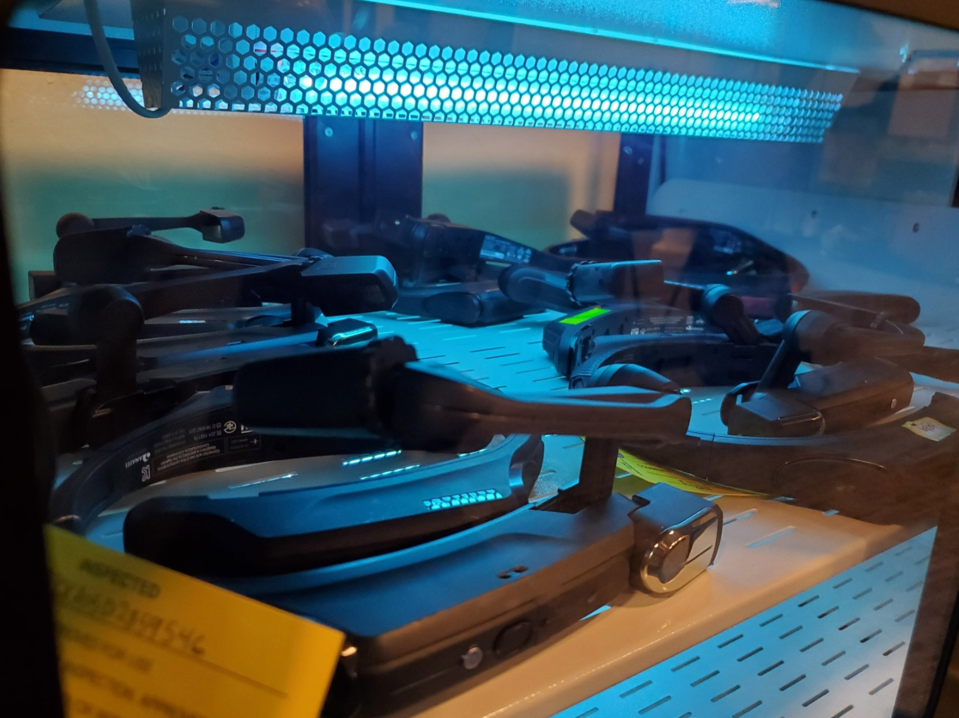
We setup the experiment using the Uvisan cabinet provided. We photographed the Archer device, photographing the main cavity body, rear rubber frame, display pod, rubber parts, and other detail areas. We placed the device into the test chamber, and exposed it to UVC radiation for 144 hours. After completing the test, we took a full set of high resolution before and after photos.
UVC Procedure
- Take close-up, high-res pictures of all surfaces on the materials you wish to test before you start the test.
- Wire an external power supply to each UVC light bank to bypass the Uvisan’s internal timer.
- Place the device into the Uvisan and turn on the UVC lights. Note: make sure the Uvisan is in an isolated area, where it won’t get disturbed or moved.
- After 144 hours (6 days) have elapsed, turn off the Uvisan, remove the device, and take another full set of pictures.
- Analyse the before and after images for discolouration or material breakdown. Run your hand across the material to see if the material feels any different from the original materials.
Drop Test Procedure
Test Case Description
- Total of 12 drops at 2 meters distance on the ground when powered on state in different angles.
- Test Height: 2.0m (Target to meet)
- Test Position: total drop 12 times from different angles
- Device is powered ON state
- Must record the dropping angle for any failure
Pass / Fail Criteria
- Fully functional
- No change in mechanical/PCB condition
- No change in electrical/functional performance
- Very minor dents, scratches or paint removal are permitted
- Slight case/cover opening is permitted, if it can be easily readjusted by hand
- External component (battery cover/battery) separation from device is NOT permitted
- Acceptable if observed defect disappears after readjustment and reset
Data Analysis
A full image gallery showing images of the Realwear HMT-1 before UVC exposure and after 144 hours of UVC exposure is available on the Uvisan web site here.
After analyzing the high-resolution macro before and after photos, there is negligible-to-no difference in the surface finishes. The HMT-1 passes the cosmetic test for UVC exposure.
The drop test passed according to the Realwear 2m drop test standards.
Summary
After 144 hours of exposure to UVC radiation, the HMT-1 shows no apparent degradation of any material. UVC cleaning can be performed at the customers discretion without damaging the HMT-1 hardware or materials. UV cleaning using Uvisan is a viable solution that will not physically damage the device. We also performed a post-UVC drop test according to the Realwear 2m drop test standard. The UVC device passed, with no physical damage, and fully working electronics.
Realwear are now confident that the UV Cabinets are suitable for all products in the Realwear range and recommend the products to be used at the customers discretion.

 By Sarah Luckhardt




Recent Comments